The Report Card Is Not the Only Record Being Built
Parents spend years monitoring report cards, grades, and school performance. But in today’s world, another record is quietly being built through group chats, screenshots, posts, comments, usernames, and online behavior. This article explores why a child’s digital record matters, how it can affect future trust and opportunity, and why families must start guiding digital habits early.
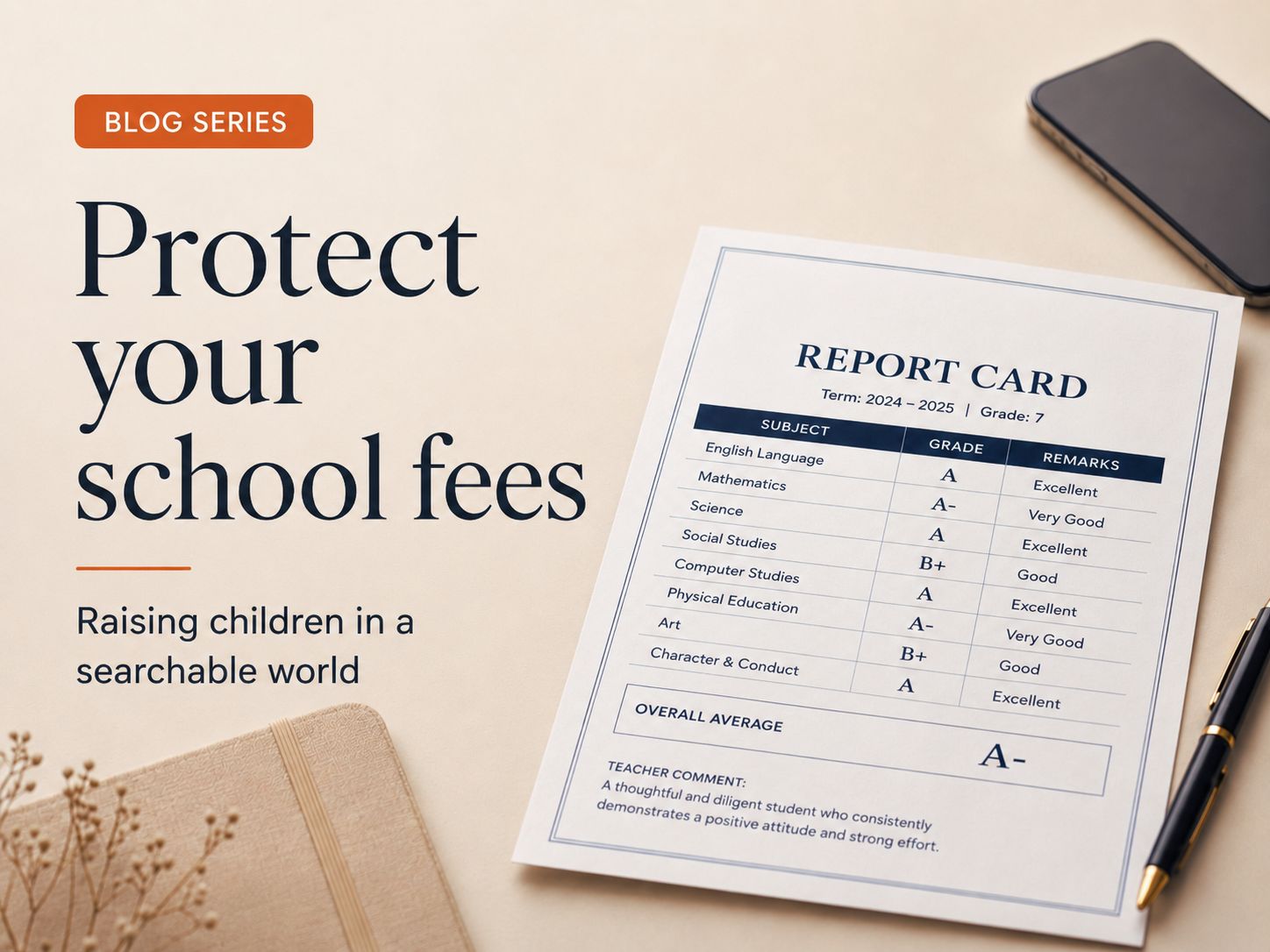
Part 2 of the Protect Your School Fees series
A parent-focused digital safety series on raising children in a searchable world.
Every term, parents wait for the report card like shareholders waiting for company results.
Some wait calmly. Others have already started calculating whether the child’s “I tried my best” will match the school fees that left the account with violence.
The envelope comes home.
Mathematics: 82%.
English: 76%.
Science: 91%.
Conduct: Good.
Teacher’s comment: “Can do better with more focus.”
And just like that, the family audit begins.
Why did Mathematics reduce?
Who is this child who overtook you?
What happened to your handwriting?
Why is the teacher saying “you need to focus more”?
Are we paying all this money for vibes?
We laugh, but it is serious. School fees are not a small thing. Parents sacrifice. Guardians stretch themselves. Some people are one school circular away from needing a chair and glucose. Education is one of the biggest investments many families will ever make.
So yes, we check the report card.
We should.
But here is the uncomfortable part.
The report card is not the only record being built.
There is another record forming quietly in the background. No envelope. No class teacher comment. No stamp from the headteacher.
This one is being built in group chats, screenshots, usernames, comments, TikTok videos, gaming platforms, private messages, search histories, deleted posts that were not really deleted, and those “I was just joking” moments that somehow always find their way into someone’s gallery.
It is the digital record.
And unlike the school report card, this one does not politely wait until end of term to come home.
Sometimes it shows up as a screenshot.
Sometimes as a forwarded video.
Sometimes as a parent saying, “Madam, is this your child?”
May we never receive that message unprepared.
A child can pass exams and still be digitally careless
This is where we need to be honest.
A child can be brilliant in class and still make poor choices online.
They can know algebra but not know how to respond when a stranger in their DMs starts acting “caring.”
They can write beautiful compositions but still leave ugly comments under someone’s photo.
They can pass computer studies but still believe every fake giveaway link that promises free data, free money, free iPhone, free future, free everything.
They can be top of the class and still not understand that the internet is not their bedroom diary.
And this is why digital safety can no longer be treated like a side topic for “children who are always on phones.”
It is now part of raising a child.
It is part of character.
It is part of reputation.
It is part of emotional safety.
It is part of preparing them for the future.
Because while the school is measuring academic performance, the digital world is quietly collecting signs of judgement.
And one day, judgement may matter as much as marks.
In our days, some mistakes had mercy
In the past, childhood mistakes had a better chance of fading quietly. At least I know mine did.
You could say something foolish, be corrected, cry small tears, eat your food, sleep, and life would continue.
A playground fight could expire after two days.
A bad joke could disappear with the school bell.
An embarrassing moment could remain with only the five people who saw it, and even those five had unreliable memory.
Now?
Someone records.
Someone screenshots.
Someone forwards.
Someone saves “just in case.”
And somehow, the thing you thought had ended is now doing international relations in people’s phones.
This is the part our children do not always understand.
Deleting is not the same as disappearing.
Apologizing is not the same as erasing.
And “I was joking” does not always survive when the screenshot is standing there like Exhibit A.
Children will make mistakes. They are children. They will test boundaries, copy friends, act silly, chase attention, and sometimes behave like their brains have gone for lunch.
That is part of growing up.
But in a digital world, some mistakes travel further than the lesson.
That is what we must help them understand.
The internet is also watching character
We teach children many good things offline.
Greet visitors.
Respect elders.
Do not insult people.
Do not gossip.
Do not follow strangers.
Do not touch what is not yours.
Do not embarrass the family name.
Then the child goes online and suddenly all those lessons are on leave.
They insult people in comment sections.
They forward embarrassing photos.
They join in group chat bullying.
They mock classmates.
They share private things.
They use fake accounts to become brave in ways they would never attempt face-to-face.
And sometimes adults laugh because “these children are funny.”
But online behaviour is still behaviour.
The child who mocks people online is rehearsing cruelty.
The child who forwards someone’s private photo is rehearsing poor judgement.
The child who hides risky conversations is rehearsing secrecy.
The child who pauses before posting is rehearsing wisdom.
The child who refuses to join cyberbullying is rehearsing leadership.
So when we talk about digital footprints, we are not only talking about technology.
We are talking about who the child is becoming when adults are not standing nearby with folded arms.
One day, the child becomes searchable
Here is where things get real.
Today’s child will not always be a child.
One day, they may apply for a scholarship.
One day, they may apply for a job.
One day, they may lead a school club, a church group, a company, a community organization, or even run for public office.
One day, they may want people to trust them.
And in that future, people may not only listen to what they say about themselves.
They may search.
They may check public profiles.
They may ask around.
They may remember screenshots.
They may look at old posts and wonder, “Is this the person we are about to trust?”
That may sound dramatic, but let us not pretend we have not also searched people before meetings, interviews, dates, business calls, and collaborations. Some of us have even searched people before replying to “Hi dear.”
So imagine paying school fees for years, only for your child’s first professional impression to be shaped by an old post they forgot existed.
Before your child writes their first CV, the internet may already have written a rough draft.
That draft should not be left completely unattended.
This is not about raising scared children
Let us be clear.
This is not about making children fear the internet.
The internet is not only danger. It is also learning, creativity, friendship, opportunity, entertainment, expression, business, and community.
We do not want children who are silent, fake, or terrified to make mistakes.
We want children who are wise.
Children who can pause.
Children who can ask for help.
Children who understand that online spaces have real-world consequences.
Children who know that posting is a choice.
Sharing is a choice.
Commenting is a choice.
Forwarding is a choice.
Joining in is a choice.
And sometimes, even silence in the face of online cruelty is also a choice.
Over time, choices form patterns.
Patterns form reputation.
Reputation affects trust.
Trust affects opportunity.
That is the bridge children do not always see.
And that is why they need adults.
Not adults who only shout after the disaster has arrived.
Adults who guide before the screenshot starts moving around like breaking news.
Parents need better questions
Many parents ask, “How was school?”
The child says, “Fine.”
Then everyone continues with life.
But in today’s world, we need to ask better questions.
Not interrogation. Not police station energy. Not every evening becoming a phone inspection parade.
Just honest, calm, consistent conversation.
Ask things like:
“What is one funny thing you saw online this week?”
“Do people in your class group treat each other well?”
“Have you ever seen someone being embarrassed online?”
“Do people share photos of others without permission?”
“What would you do if someone online asked you to keep a secret?”
“What do you think your online profile says about you?”
“If someone searched your name in five years, what would you want them to find?”
These questions may sound simple, but they open doors.
They teach the child that their online life is not a hidden kingdom where parents are permanently denied entry.
They also help parents notice things early, before they become family meetings with serious faces and mineral water on the table.
Try a monthly digital record check-in
Once a month, sit with your child and do a simple digital record check-in.
Not as punishment.
Not as ambush.
Not with the mood of “today we shall see who gave birth to whom.”
Make it normal.
Review their profile picture, username, bio, public posts, comments, privacy settings, group chats, tagged photos, and the kinds of accounts they follow.
Then ask one powerful question:
“Does this reflect the person you are becoming?”
That question can do more than shouting.
Because the goal is not just obedience.
The goal is reflection.
You want the child to develop an inner pause. That small voice that whispers:
Should I post this?
Could this hurt someone?
Could this embarrass me later?
Would I be comfortable if my parent, teacher, future employer, or future child saw this?
That pause is digital wisdom.
And digital wisdom is now part of protecting the future.
Protect the fees. Protect the future.
Parents, the report card still matters.
Check it.
Ask about the marks.
Attend the meetings.
Support the weak areas.
Celebrate improvement.
But remember this:
The report card is not the only record being built.
Your child is also building a digital record.
And one day, that record may speak in rooms where you are not present.
It may speak when they are applying for opportunities.
It may speak when people are deciding whether to trust them.
It may speak when they are older and hoping the world will see who they have become, not only who they were when they were young and foolish.
So let us guide them early.
Not with fear.
Not with shame.
Not with surveillance alone.
But with conversation, boundaries, wisdom, and love.
Because school fees open doors.
But digital wisdom helps children walk through those doors without dragging avoidable harm behind them.
The report card tells us how they are performing.
The digital record may tell the world who they are becoming.
Let us pay attention to both.
Next step
Learn moreComments
Comments are moderated. Your email is kept private.
Loading comments…