Scammers Love Speed. Slow Down and Frown.
Scammers often win by getting us to act before we have time to think. Slow down and frown is a simple cyber-safety habit that helps interrupt that pressure. Before you click, pay, share or approve anything, pause, question the request and verify it independently. Sometimes the few seconds you take to let your judgement catch up are exactly what stop a scam.
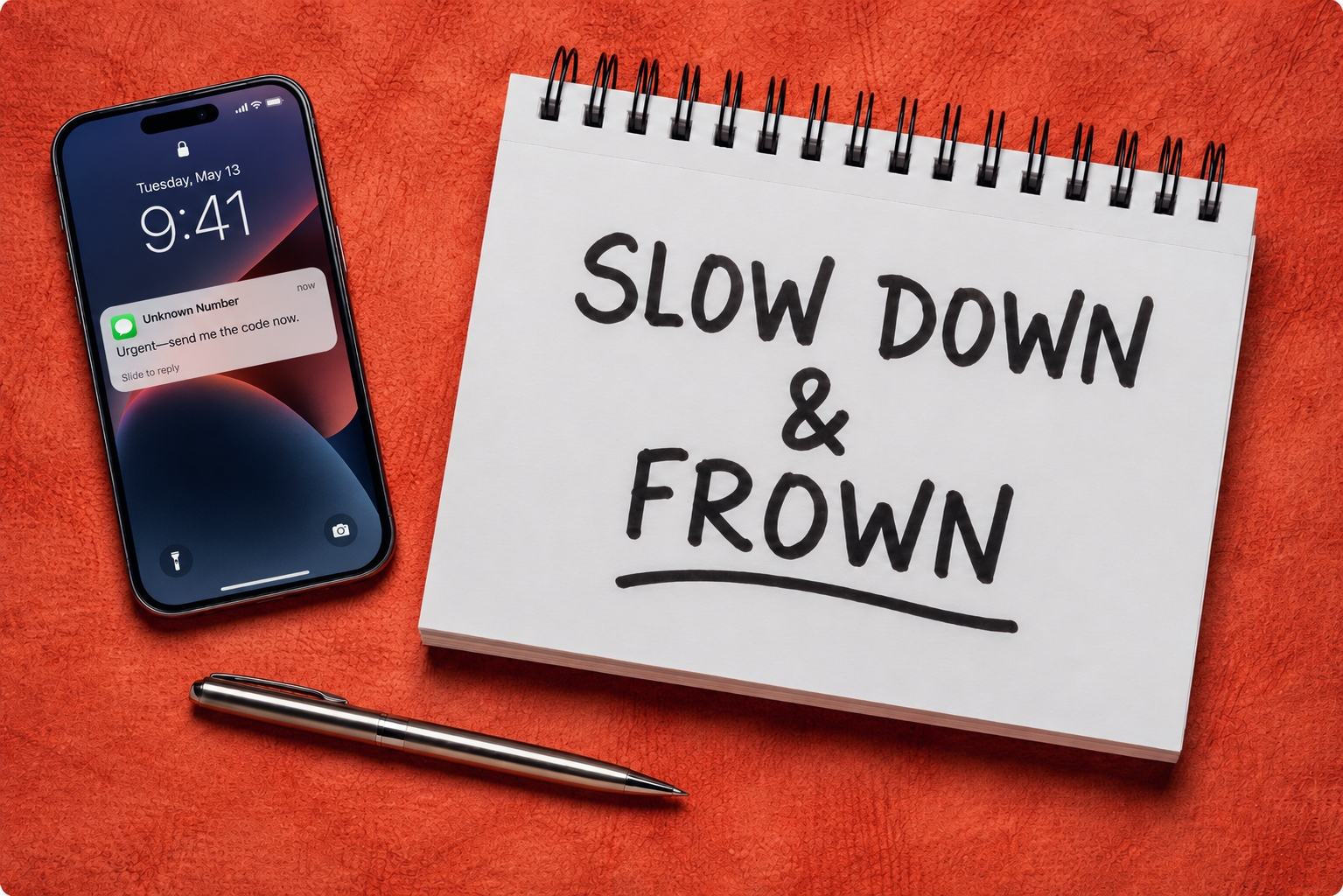
You receive a message: “URGENT: Your account will be suspended today. Click here to verify now.” Or perhaps it is someone claiming to be your boss asking you to make a payment immediately because they are “stuck in a meeting.” Maybe it is a mobile money message telling you that money was sent to you by mistake and must be returned quickly. Different stories, different platforms, but often the same strategy: get you to act before you have enough time to think.
One of the ideas that stayed with me after reading George Finney’s Well Aware was the wonderfully simple phrase: slow down and frown. I like it because it turns cyber safety into something practical. You do not need to remember twenty phishing indicators while someone is pressuring you. You need to recognize the moment your judgement is being rushed and deliberately create a little space between the message you received and the action you are about to take.
Scams are not only attacks on technology. Very often, they are attacks on how we make decisions. A scammer may use fear by telling you that your bank account has been compromised. They may use authority by pretending to be your boss, your bank, the police or another organization you trust. They may create excitement with an unexpected prize or investment opportunity. They may even exploit kindness by pretending to be a friend or relative who urgently needs help. The story changes, but the attacker is trying to create an emotional state strong enough to move you from thinking into reacting.
That is where speed becomes useful to the scammer. When we feel rushed, we are less likely to ask questions such as, Why is my bank asking me for this information? Why is this person contacting me from a different number? Why must this payment happen right now? Why am I being asked for an OTP? Why can’t I call them first? The scammer does not necessarily need you to be careless. They simply need you to make one decision before your judgement catches up.
So, slow down. This does not mean spending thirty minutes investigating every email, message or phone call. It simply means refusing to let someone else decide how quickly you must act. If a message tells you that your account will be blocked unless you click a link immediately, do not begin with the link. Open the official application yourself or contact the organization using details you already know. If someone claiming to be a relative suddenly asks you for money from a new number, call the number you normally use for them. If your boss appears to be requesting an unusual payment, verify the request through another trusted channel.
When you do that, something important happens: you take control of the interaction away from the scammer. Instead of following the path they created for you — their message, their link, their website, their instructions — you step outside it and verify independently. That small interruption can be enough to expose a scam.
Then comes the second part: frown. I do not mean that we should become suspicious of everything online or walk around permanently distrusting people. The frown is simply a reminder to bring a little healthy skepticism into situations where someone wants you to click, pay, share, approve or disclose something. Think of it as your internal “Hmm… wait a minute.”
Your account will apparently disappear in thirty minutes? Frown. Someone you know suddenly needs money but cannot take a phone call? Frown. An organization is asking you to share an OTP? Frown. An unbelievable deal is available only if you pay immediately? Frown. The question becomes less about whether the message looks convincing and more about whether the request itself makes sense.
This is important because scams are becoming increasingly polished. A message can contain the right logo. A fake website can look almost identical to the real one. A scammer may know your name, where you work or even the names of people you know. With AI making convincing messages, voices and content easier to create, “it looked professional” is becoming a weaker reason to trust something. Healthy skepticism gives you permission to ask a better question: Can I verify this independently?
There is one important warning, though. Not every scam moves quickly. Some scammers are incredibly patient. Romance scams, investment scams and other forms of social engineering may develop over weeks or months. The attacker may spend considerable time building trust before asking for anything significant. So “slow down and frown” should never become a rule that says urgent equals scam and slow equals safe. Instead, it is a habit for those moments when you are being asked to make a decision that matters, particularly one involving money, passwords, personal information, account access or an unusual request.
And sometimes, after slowing down and frowning, the correct action is simply to do nothing.
We often behave as though every message deserves a response and every notification requires action. It does not. You are allowed not to click. You are allowed to end the call. You are allowed not to send the money. You are allowed to verify first. You are allowed to walk away from a transaction that does not feel right. A legitimate organization can survive the few minutes it takes you to verify a request. A scammer desperately trying to keep you moving may not.
Cybersecurity is often described through firewalls, antivirus, encryption and sophisticated security tools. All of those matter. But there is another important control sitting between the attacker and the action they need from you: your judgement.
Sometimes good cyber safety looks remarkably boring. You receive the message. You feel the urgency. Your thumb almost moves towards the link. Then you stop. You question it. You verify it somewhere else. Perhaps you delete the message and continue with your day.
Nothing dramatic happens.
And that is exactly the point.
Scammers love speed. Slow down and frown. Give your judgement time to catch up.
Comments
Comments are moderated. Your email is kept private.
Loading comments…